Showing posts with label climate crisis. Show all posts

Friday, January 2, 2015

Why renewable EROI matters


Somewhat naively, I used to think that the only thing that mattered for a sustainable future was the price point of energy from renewable sources. With rising prices for fossil fuels (primarily oil) and falling prices for renewable energy (due to efficiency improvements) it was only a question of time before the big switch was coming. In fact, recent news of Germany's energy giant EON retiring its conventional energy business to focus on renewables and power distribution seemed to be a clear indicator of this mechanism at play.

However, there is more to this story. In a recent quarterly newsletter, GMO's Jeremy Grantham discusses the beginning of the end of the fossil fuel revolution (starting page 12 in the Q3-2014 issue). I am a big fan of Grantham's data driven and common sense review of market mechanisms. Despite the recent price drop due to short lived US fracking sources and OPEC response to it, the times of cheaply available oil are over. The debate about peak oil, the point at which maximum possible oil extraction is reached, and oil subsequent depletion, at which oil reserves are used up faster than new ones are discovered, seems to have been settled in recent years. It is mostly the point in time for the peak to occur that seems debatable, but even that is generally placed within a decade or so. I recommend a look at part one of the transition handbook or the Post Carbon Institute to get a deeper understanding of the details.

So why does this matter so much? Can't we just switch over to eternally affordable renewables if we need to? Here is where EROI  (also often called EROEI) comes in. The "energy return on investment" is crucial to our current lifestyles. In the early oil days, an investment of $1 would have returned $100 worth of energy (an EROI of 100). In recent years, this has steadily declined as oil is much harder to come by. In some scenarios, we are reaching almost negligible ROI on oil extraction.
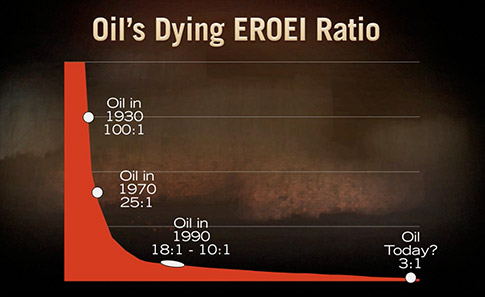

More so, if energy was once available at, say, $10, and the value it created was about $200 (a low boundary in Grantham's research), then our society benefited from an energy surplus worth $190 on each barrel extracted! It is this surplus that fueled our growth oriented, wealthy lifestyle. All sorts of convenient uses of oil were possible due to this surplus.

The second key element here is what we do with this value. If we use a barrel of oil as fuel to operate heavy machinery, one man can do the work of hundreds hence adding significantly to our level of prosperity. If, however, the same barrel is going to low value uses (e.g. throw away plastic wrappings, unnecessary transportation of goods, inefficient energy use, etc.), it does not add to our level of prosperity. One could argue that continued reduction in EROI will eliminate low level uses of energy sources.

Now, back to renewables. The question is not whether we can replace our conventional energy sources with renewable ones in a short enough time frame. This switch has to happen for climate reasons alone and will be one of the largest challenges mankind has faced so far. And, according to David MacKay's research "Sustainable energy - without the hot air" , a quiet improbable undertaking in itself.

But even if we pull it off, renewables as it stands have a radically different EROI than fossil fuels in their hayday. It takes quite some energy to produce solar panels, so their return is maybe 7:1 (outside of the interesting concept of "solar breeders"). Hydro is the strongest contender, but even the best estimates do not go over 40:1 and it comes with limited scalability of hydro locations. Wind energy might lie somewhere between that with 18:1. Given that our growth based economies fundamentally depend on high EROI and that the return for fossil fuels is not only dwindling but the resource itself is rapidly depleting, we have to seriously think about the implications for our global economic system and our consequently our daily life styles.

In summary, instead of just looking at how we can quickly increase our percentage of renewable energy sources as part of our overall usage, we need to aggressively become more efficient in all forms of energy use and eliminate low-value uses to preserve the crucial high-value uses that support our quality of living. It is very questionable to me if our current consumer societies can be sustained with quickly dwindling fossil resources. That party is simply over.


----------------------
Some reading material:


Thursday, December 18, 2014

Transition to efficiency

Last week I attended a talk given by Prof. Dr. Ernst-Ulrich von Weizsaecker on the subject "more prosperity with less usage of resources". A long term thought leader in the field of sustainability, specifically by political and economic measures, von Weizsaecker made the following very valid points:

  • The world is going to fail on the vast majority of our climate goals and is now changing the discussion from avoiding the crisis to dealing with the consequences. Why did no one act?
  • GDP and CO2 emissions as well as GDP and consumption of natural resources are strictly correlated. That's why all developed countries want to avoid emission reductions and developing countries want to increase their footprint. It raises the prosperity.
  • We need to find a way to break this strict correlation and allow for prosperity that is clean and efficient on resources (a new "Kuznets curve"). More so, we need to not only convert existing developed economies but tunnel the emerging economies directly to that state.
  • Despite the short lived "success" of fracking and shale gas (even larger fields drain in only a few years), carbon-based energy sources oil, gas and coal are dwindling and passed their peak points. There is no alternative to switching to renewable energy sources.
  • However, even if we were to realize our currently defined climate goals and reduce CO2 emissions by 20% over 1990 levels, this would only account for a part of the footprint of a fraction of the worlds population. 
  • Therefore, von Weizsaecker proposes, we need a solution composed of:
    • 30% less CO2 emission from our energy consumption (i.e. more renewables)
    • 65% less need for energy (!!!)
    • 5% less prosperity (are we really happy with all the "stuff" we have?)
  • Radical gains in efficiency are nothing short of a technical revolution comparable to our leaps into the industrial or information age (a 6th Kondratiev wave). It will require ingenuity, innovation and fresh thinking. Entrepreneurs to the fore front!
  • In the past, most gains of efficiency have been negated by a drastic increase in use of a given resource. This is called the "rebound effect" or Jevons paradox, an old phenomena observed with many efficiency leaps. With LED lights being efficient (cost per lumen), we simply install a lot more of them and light up the planet.
  • Therefore von Weizsaecker suggest to reflect the true cost of natural resources and commons in market prices by increasing their price as we become more efficient in their use. The destruction of nature must not get cheaper by technological advances, but more expensive. 
  • Market actors must be rewarded for their efficiency gains and punished for their resource use. This will set in motion a spiral of innovation and efficiency and can ultimately lead us to a "factor 5" in efficiency.
  • One pointed question stuck with me: "What can 1 kilowatt hour do for us?" As an example, how many kWhs does it take to lift a 10 liter water bucket (say 10kg) from sea level to the top of Mount Everest (8,800 m)? Have a guess and scroll down for the answer. 
While the situation remains clearly dire overall, I found his view inspiring putting the focus on radical innovation to achieve efficiency. Rather than (only) talking about solar panels, talk about all forms of efficiency gains in transportation, manufacturing, housing, etc. Instead of just policy, we need to think innovation (although I don't subscribe to the Cornucopian world view that technology will save us all anyways by divine right).


p.s. It takes only 1/4 kWh to lift 10 kg to the top of Mount Everest (with a gravitational constant of 9.8 on our lovely planet, 1 kg for 1 meter takes 9.8 joule or 0.002722 Wh so for 10 kg and 8,800 meters that makes 0.239556 kWhs). Now compare this to your next energy bill and ask if we are using or wasting all that energy...